Blog
How TypeSafe's Jev changes RL training environments
Integrating Jev into an environment built around generated text requires explicit action mappings and uncertainty thresholds, with independent outcome checks.
Published September 19, 2026
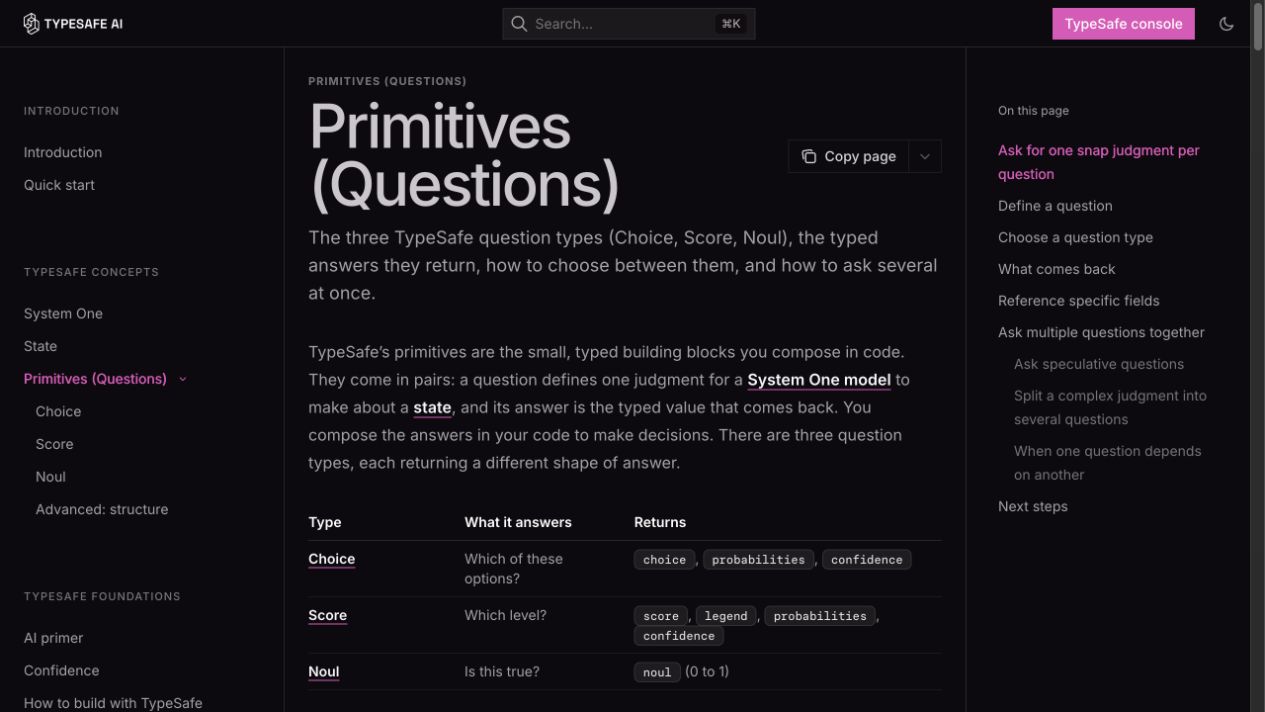
For a reinforcement learning (RL) environment built around generated text, integrating TypeSafe’s Jev requires explicit mappings from its bounded decisions to permitted actions. Jev offers three question types, documented as of September 19, 2026: Choice selects an option, Score rates a defined scale, and Noul estimates whether a statement is true. An RL environment is a resettable system in which an agent takes actions and receives rewards tied to the results. For buyers, our judgment is that decision models make it more important to specify what evidence the agent sees and when it should defer. There is also a practical limit: TypeSafe’s current model documentation says customers cannot fine-tune Jev’s weights. Using its hosted service inside an environment is therefore different from training Jev itself. These are proposed design implications for a larger system; rlsupply has not announced a Jev integration.
What changes when the model returns decisions?
The environment needs an explicit mapping from each decision to an action. TypeSafe founder Diogo Almeida’s September 15, 2026 launch announcement presents Jev as a model for software decisions. Its routing documentation describes selecting a handler while code performs the subsequent work.

For a proposed support environment, that could mean choosing to request missing evidence, execute an eligible account change, or escalate. These are design examples, not measured Jev results. Each choice should produce an observable state change or a recorded handoff that the environment can score.
A smaller action menu also transfers work to the task designer. If code has already selected the relevant evidence and removed every bad option, success says less about the model’s judgment. Buyers should ask what assistance is supplied before the decision and whether competing systems receive the same assistance. Our environment catalog and task datasets and rubrics address different parts of that specification; neither should be treated as interchangeable with a model call.
“Jev can't generate text”
In his launch thread, Almeida identifies text generation as a capability Jev does not provide. This is the founder's description of the model.
Which part of the system is being trained?
Name the component whose behavior changes before calling the setup RL training. A hosted Jev call can be part of an episode, a complete attempt at a task, without its weights being updated. The model documentation, checked September 19, says customization happens through supplied state and questions, with the same model weights serving each account.
An environment purchase should distinguish these possible roles:
- Acting policy: the component that selects actions. A fixed Jev policy can be evaluated against the task.
- Router: a component that assigns work to another model or a person. A separate trainable policy could learn when to use it.
- Auxiliary judge: a component that supplies a semantic assessment, such as whether a response addresses the request. That assessment needs validation before it affects reward.
Our recommendation is to keep these roles explicit in the task specification. If a separate policy is learning, record what it can change and what stays fixed. Prompt revisions, threshold tuning, and model-weight training are different interventions; improvement after one does not demonstrate improvement from another.
How should uncertainty affect the reward?
Score the consequences of acting or deferring against the task’s requirements. Calibration means that predicted probabilities agree with observed frequencies across comparable cases. It must be checked on representative cases before a threshold is used to decide when the system acts automatically.
TypeSafe’s confidence documentation explains that Choice and Score include a summary of the probability distribution, while Noul does not carry a separate confidence field. The threshold remains an application decision. A threshold that works for classifying a support request does not automatically work for authorizing an account change.
The environment should retain the observation, returned probabilities, chosen action, and observed outcome. Evaluate the quality of automatic decisions alongside the share of cases deferred and the cost of that review. Otherwise a system can appear reliable simply by declining difficult work. Include cases where asking for more evidence is useful and cases where it only delays a supported action. That is an extension of capturing expert judgment in exceptions, with uncertainty made inspectable.
Can Jev replace the environment’s verifier?
A Jev assessment needs independent validation before it can influence reward. A verifier is the check that determines whether an action met the task’s success conditions. When a database record can establish completion, that evidence should remain the basis of the grade.
TypeSafe’s limitations page, reviewed September 17, 2026, warns that adversarial text can influence answers. In a training environment, an agent may learn to produce text that persuades a judge without completing the required operation. A constrained answer format leaves that failure possible.
Our published methodology grounds grading in recorded expert work and, wherever possible, software state. For a decision-model environment, we would keep that boundary: use learned judgments for the aspects that need interpretation, validate them against independently reviewed cases, and retain code checks for directly observable results.
What should buyers ask for?
Request a sample episode showing the evidence available to the model, its permitted actions, and the resulting grade. The accompanying record should identify the model version and decision criteria, including the conditions for escalation. Keep evaluation cases separate from the cases used to adjust those criteria.
TypeSafe’s launch makes this design worth examining; it does not establish a measured training gain for an rlsupply environment. Buyers considering a decision model alongside a generative agent can request a sample packet with the action interface and verification requirements stated explicitly.
Request supply